

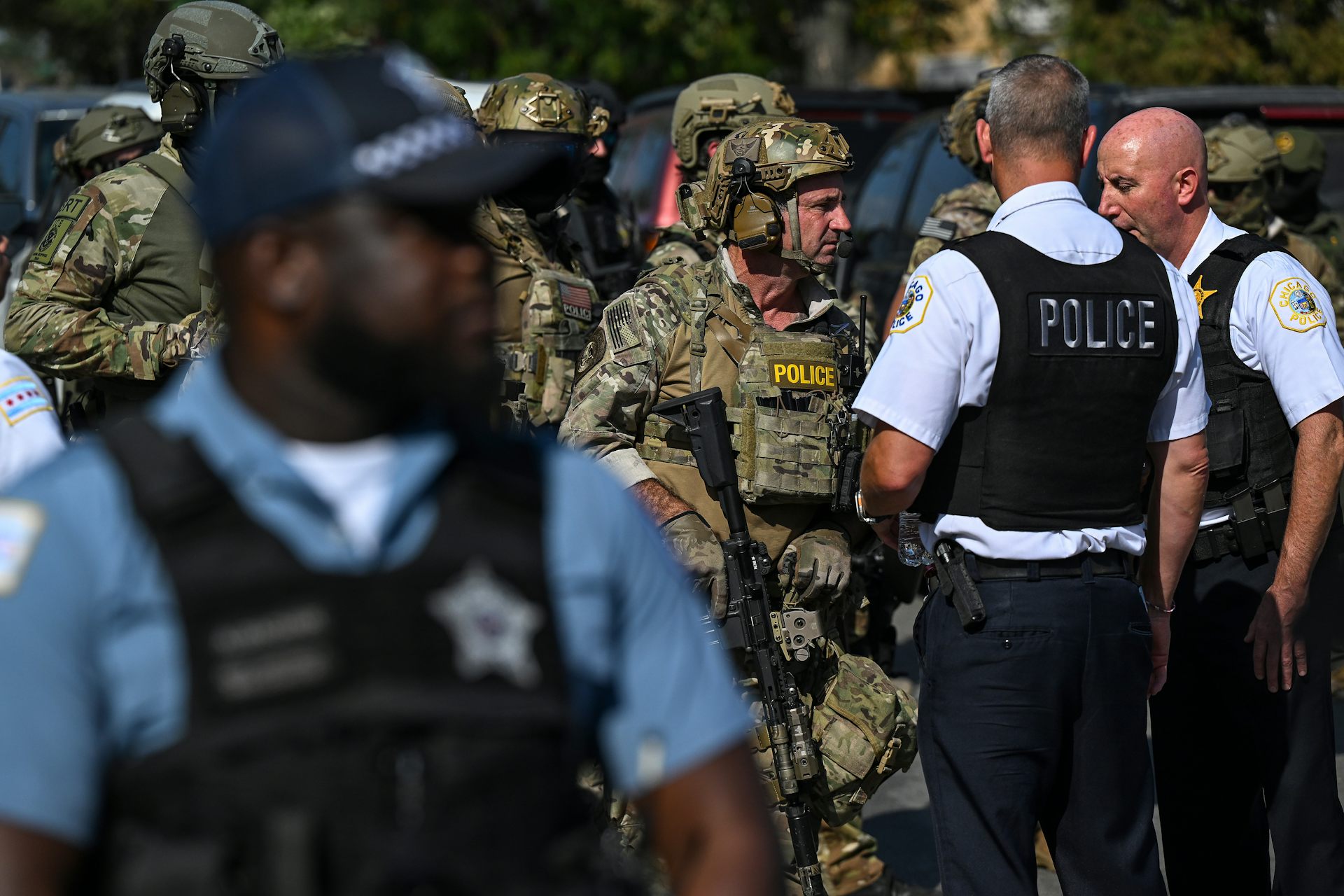
In early 2025, in an effort to facilitate its deportation goals, the Trump administration entered into hundreds of agreements with local police departments to essentially deputize them to act as federal immigration agents.
The bulk of these agreements were signed in Republican strongholds such as Texas and Florida, places where the immigration policies of state leaders aligned with those of the Trump administration.
But as Trump ramped up his deportation efforts over the course of 2025, how would immigration enforcement play out in sanctuary cities and states?
Sanctuary policies aim to focus local policing on community safety rather than immigration enforcement. In 2016, there were approximately 340 of these sanctuary jurisdictions in the U.S. By the start of Trump’s second term, there were just over 1,000 of them
Would local police in sanctuary cities and states step in to protect someone they knew hadn’t committed a felony or was a citizen? Would officers in these places admonish ICE agents for failing to follow proper protocol?
Instead, over the course of 2025, videos from sanctuary jurisdictions – including Chicago, California and Worcester, Massachusetts – showed local police acting more like auxiliary enforcers.

In Peter Mancina’s forthcoming book “On the Side of ICE: Policing Immigrants in a Sanctuary State,” he explores the cultural, bureaucratic and political roadblocks to enacting immigrant-friendly policing reforms, with a focus on New Jersey, where Mancina works as an adjunct law professor at Rutgers University.
In an interview, edited for length and clarity, Mancina explains why sanctuary policies don’t necessarily change what happens on the ground.
The adoption of sanctuary policies grew dramatically during the first Trump administration. Yet at various points in the book, you call them a “rebrand,” a “public relations facade” and “immigration enforcement assistance with an immigrant friendly face.” What’s behind those characterizations?
There’s an internal tension to sanctuary policies. There’s this broader sanctuary movement that’s been around since roughly 1980, which came about largely in response to U.S. involvement in Central American civil wars and protecting immigrants fleeing these and other conflicts.
The activists started working with city officials sympathetic to their cause in cities such as San Francisco to create resolutions protecting immigrants that were largely symbolic. After the San Francisco Police Department was found to be ignoring the resolution, the city created the country’s first sanctuary ordinance in 1989. With this ordinance, activists hoped that local police could be prevented from collaborating with federal immigration officers.
But many activists assumed that the kind of ethics and the values that existed in the sanctuary movement could actually be taken up in policy and implemented, because there’s this notion that when you pass a law or ordinance it will be implemented as written.
A major part of the book is to say, “Actually, that’s not how policy works.” It fits within these bureaucratic cultures. And in policing culture, there’s already this web of relationships that local cops have with federal agents, and these cultures have their own value systems. Something that people don’t really talk about is that local police aren’t just used by ICE as these local enforcers of immigration law. In fact, a lot of times local law enforcement look to ICE as partners and collaborators.
Where does the breakdown happen between policy and practice?
These current policies largely acknowledge the fact that the majority of the undocumented people that local law enforcement encounter don’t have criminal backgrounds. They say that what we want to target are these really terrible people who are the violent criminals.
These criminals are framed as the exception to the rule. But these exceptions still end up leading to quite a few people being transferred by local police and jails to ICE. And the exceptions can easily be exploited or broadened by the boots on the ground – the police tasked with following the policy – because there’s often this gray area in the language.
So what ends up happening is that there really isn’t any sort of major decrease in deportations in sanctuary jurisdictions. In 2018, New Jersey Attorney General Gurbir Grewal issued his Immigrant Trust Directive, which barred local law enforcement from helping federal authorities carry out civil-immigration enforcement. The last year before it was implemented, local police turned 1,000 people being held in local jails over to ICE. After it went into effect, that number went down slightly the following year, to 700 people. That’s still a lot of undocumented people being turned over. And it’s because local police were able to apply those “exceptional circumstances” in many of those cases.
In Trump 2.0, roughly two-thirds of immigrants in the custody of ICE have no criminal background. During the Biden administration, 42% of them had no criminal background.
In the book, you relay this one instance in New Jersey where ICE calls in the local police as backup, and the local police – aware of the state’s new Immigrant Trust Directive – describe their role on the scene to local activists and passersby as “protecting public safety.” Yet you point out that they actually are helping ICE, because their cars are parked to block the street so the targeted immigrant can’t drive away.
You can have a policy, like the one that the Los Angeles City Council passed in 2024, which was basically written as a “no cooperation policy.” And still, it’s not possible to actually pull off in practice, because you then have those cases like the one you just mentioned, where even if you ban “immigration enforcement practices” like making immigration-related arrests, basic public safety policing is going to still happen, whether that’s crowd control or traffic control.
So when local police show up at an immigration home arrest or a worksite raid, they often become part of immigration enforcement by virtue of the fact that they’re there to protect pedestrians, route traffic, respond to violence or protect ICE agents.
You’ll see this on social media, when protests rapidly form to surround ICE officers during raids. Police step in to assist ICE by protecting them as they haul someone away. This turns emergency assistance and crowd control into a form of immigration enforcement itself.
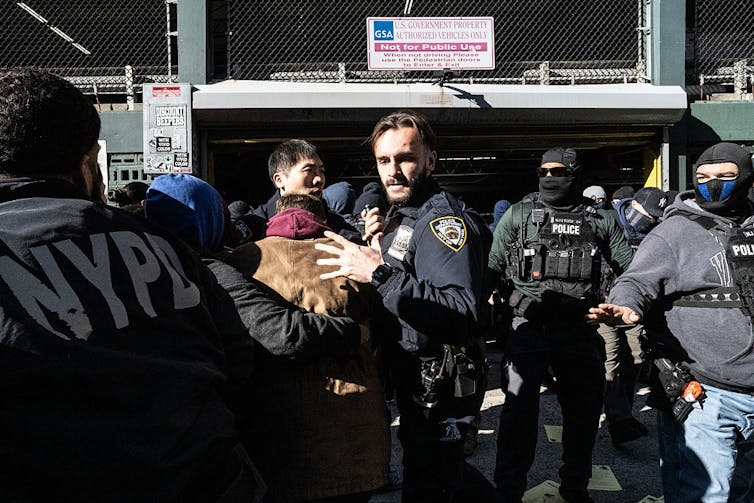
Ultimately, when you get down into the procedural level of how you implement this stuff, it’s actually not possible to avoid cooperating. Complete non-cooperation and complete protection simply do not happen.
I’ve also seen local law enforcement agencies in sanctuary jurisdictions simply post all of their inmate information online. ICE agents can routinely check those databases and show up to arrest them once the inmates are released.
Under the George W. Bush administration, there was the Secure Community program, in which the Department of Homeland Security required local police to check the immigration status of anyone that they fingerprint. The Obama administration actually expanded this program. How have programs like this facilitated what you describe as a “professional kinship” between local police and federal agents?
The way I see it, local police and federal agencies have different missions and different objectives, but they see themselves as being able to help each other accomplish their various goals.
Many local police departments have long seen deportations as just another tool that they can use to get criminals off the street for good. Once they’ve arrested an undocumented person, they assume that if they’re deported, there won’t be an opportunity for them to return to the community to commit more crimes. And this view has been ingrained and reinforced through these collaborative partnerships like the Secure Communities program.
Interestingly, during the height of the Secure Communities program, (legal scholars) Adam Cox and Thomas Miles conducted a statistical analysis of 3,000 counties from 2005 to 2013 that assisted ICE by turning people over to them from local jails.
They found, across the board, that crime in these counties didn’t decrease. It sounds counterintuitive. But when most people deported through jail transfers are people with low-level jail bookings – and not serious convictions – it makes more sense. It also doesn’t stop people who are part of a criminal enterprise from figuring out a way to get back into the country after being deported.
I want to go back to that term “sanctuary.” Opponents of sanctuary policies seem to have used it as a cudgel, and I think that’s because the layperson understands “sanctuary” as total protection. You obviously show that not to be the case. Have you seen elected officials avoiding the term?
Around 2011 or 2012, officials started walking back the way they framed sanctuary policies. They were clearly sanctuary policies in terms of how they’d been crafted and what they attempt to do. But places like Chicago, for example, called theirs a “Welcoming City” ordinance.
These new terms emerged largely due to attacks by right-wing outlets such as Fox News and Breitbart. There was just a lot of bad press.
And, yeah, politicians are running away from the term: I’ve heard different ones say, you know, “This is not a sanctuary policy,” even though it’s been crafted using almost the exact same language as policies that are explicitly described as sanctuary policies.
As I noted earlier, there was a time when activists and lawmakers thought these policies really were going to stop local jails and local police from helping to deport people. They just didn’t anticipate the durability of local-federal partnerships and their tenacity in finding ways to circumvent the intentions of lawmakers.
I think over time – as the spirit of these policies continues to be violated by many local law enforcement officers – the term “sanctuary” has been used in more of an aspirational sense.
Do local officers ever get disciplined for violating sanctuary policy?
I actually studied this – separate from the book – in San Francisco, where the police chief had issued a sanctuary city order.
If an officer violates a local department order, it can go in their police file. These write-ups can add up and can lead to an actual firing under police union rules.
In every single case where there was a violation of the sanctuary rules, the only thing that was issued was a verbal admonishment. So no write-ups. It’s the equivalent of someone saying, “Don’t do that again,” and leaving it at that.
They knew their superiors were aware. So it was not nothing. In certain circumstances, those who had violated the order were told to go back to the San Francisco Police Academy for training on the sanctuary ordinance.
But none of it went into their files. You could say it was a very lenient culture around those rules.
Returning to New Jersey: Was there any follow-up on whether local police departments were adhering to the Immigrant Trust Directive?
So when the trust directive was implemented, the New Jersey attorney general’s office created training for all law enforcement officers. It was an online video that they had to watch. It was a few hours long. It was very technical. I watched it. Though some officers were allowed to do other work while watching, they all had to do it, and there was a very firm accounting of ensuring that every officer got that training.
I also know that in the first year, they required local agencies to report back any instances of cooperation with federal immigration authorities. But after that first year, the follow-up seems to have stopped altogether. There were no further documented reports.
I also managed a team of researchers that did a public records request of over 400 agencies across the state. I wanted to see whether local police departments had changed their policies to include the dictates of the Immigration Trust Directive.
I was able to get access to records from 68% of all law enforcement agencies in the state. Of those, only 55% had actually changed their procedures so they were compliant with the Immigrant Trust Directive. Keep in mind, there were still pro-immigration enforcement procedures that were already on the books from Anne Milgram’s tenure (New Jersey’s attorney general from 2007 to 2010), when officers were encouraged to inquire about immigration status. It turns out many departments didn’t even tweak these internal policies and procedures.
What has stood out to you about the deportation efforts of the second Trump administration?
What’s happening are extensions of what’s been happening over the past few decades, in terms of the federal government looking to partner with different agencies at the local, state and federal levels, whether it’s sheriff’s departments, the ATF, the FBI or the Secret Service.
But none of this coordination has ever happened to the degree we’re seeing right now. The administration is assigning people within these various agencies to do full-time immigration enforcement.
What’s been really amazing to me, too, has been the amplification of the 287(g) program. These are agreements signed with the Department of Homeland Security that permits local police officers to go out and find undocumented people to arrest and be potentially deported in the course of their everyday policing activities. So it allows them to double as a federal officer.
At the start of 2025, 135 local law enforcement agencies throughout the U.S. had signed these agreements.
Now over 1,000 agencies have signed on. Every single sheriff’s office in Florida is currently under a 287(g) agreement.
Over the course of your 15 years studying sanctuary policing – either for this book or for your other studies – did you ever encounter instances where local police arrived at the scene of an ICE raid or an arrest and took the side of undocumented immigrants or citizens for one reason or another, whether that meant admonishing ICE agents for their aggressiveness or telling them, “Hey, you’re not following proper protocol.”
No, not a single time.
Nick Lehr, Senior Arts + Culture Editor, The Conversation
This article is republished from The Conversation under a Creative Commons license.
