

So-called converse 1983 statutes are percolating in statehouses across the country and could fill a critical constitutional gap.
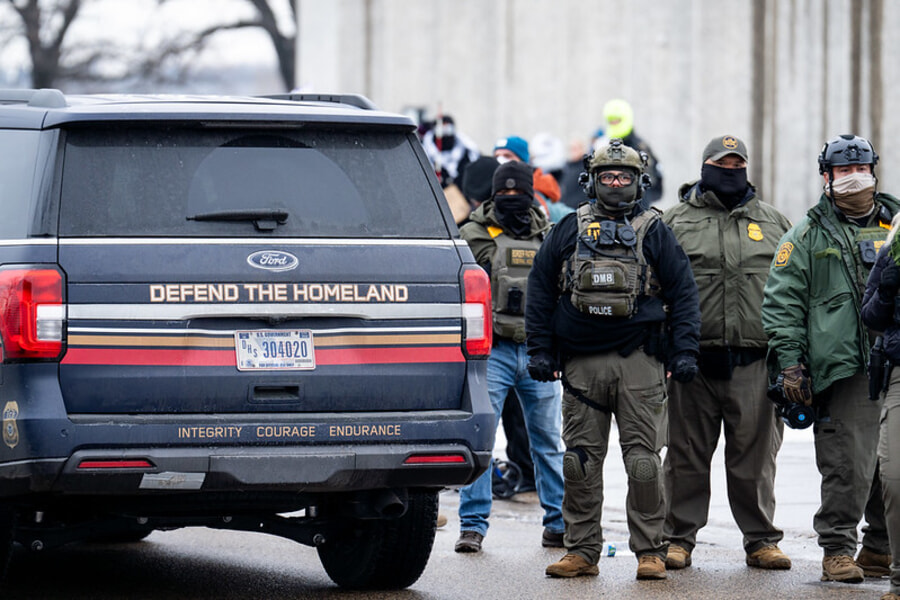
From Portland to Minneapolis, aggressive actions by Immigration and Customs Enforcement (ICE) agents against citizens and noncitizens alike have been well documented. Many of these encounters raise grave constitutional concerns. Yet it may surprise—and alarm—many to learn that there is often no viable path to sue federal officers if they violate your constitutional rights, even egregiously.
States are looking to fill this gap. In statehouses across the country, legislators are considering damages remedies—often dubbed “converse 1983” statutes—that would authorize suits against federal officials if they violate constitutional rights. And while these statutes pose thorny questions, their legal footing and historical pedigree are likely stronger than some might assume.
A Constitutional Dead Zone
To offer meaningful protection, rights need remedies. Litigants can often pursue an injunction when trying to stop ongoing or prevent future harm. But for harms that have already occurred, including constitutional harms, money damages are primarily how the U.S. legal system rights a wrong. In fact, they are sometimes the only way; as Justice John Marshall Harlan II wrote, for many victims of unconstitutional conduct, their recourse is frequently “damages or nothing.”
Unfortunately, it has never been harder to sue federal officials for damages for violating your constitutional rights.
The best known mechanism for litigating constitutional torts is 42 U.S.C. § 1983. But that 1871 law provides a cause of action for damages against state and local actors only. There is no parallel federal statute authorizing suits against federal officials—and while Congress could fill that gap with a simple fix, it hasn’t.
Amid that vacuum, in 1971 the U.S. Supreme Court held in Bivens v. Six Unknown Named Agents of the Federal Bureau of Narcotics that, even without direct statutory authorization, plaintiffs should be able to sue for damages when federal officials violate constitutional rights. But since then, the Supreme Court has expressed skepticism that courts—as opposed to Congress—should be in the business of inferring causes of action. As a result, it has radically scaled back these so-called Bivens actions—making clear that courts should not recognize a cause of action in any factual circumstances different from Bivens and two other highly specific fact patterns. In one recent case, the Court held that Bivens did not authorize a suit against a border patrol agent who shot and killed an unarmed teenager. As one scholar put it, for today’s victims of unconstitutional action, Bivens remedies are “essentially nonexistent.”
Historically, state common law tort suits offered another path to recovering damages from federal officials who transgressed statutory or constitutional bounds. But since the late 1980s, those claims are preempted largely by the Federal Tort Claims Act (FTCA), which establishes the exclusive pathway for individuals to seek damages directly from the federal government for most state law torts. And while individuals can sometimes obtain recourse through the FTCA, there are significant procedural hurdles and large carve-outs. Significantly for actions against individual agents, the FTCA contains an exception for injuries stemming from anything that requires “discretion”—as many law enforcement operations do. Perhaps most glaringly, the FTCA also fails to waive the U.S.’s sovereign immunity for constitutional torts, meaning that litigants can’t bring claims rooted in doctrines such as Due Process, Equal Protection, or other constitutional provisions that may lack a private analogue.
The result is that people whose constitutional rights were violated often don’t have a way to recover money damages. As Steve Vladeck and others have noted, it wasn’t supposed to be this way—as recently as the 1970s, individuals had multiple paths to sue federal officials for constitutional violations. But through a combination of judicial rollbacks and congressional preemption, those doors are largely closed. The current landscape therefore leaves a constitutional vacuum in which victims frequently have no recourse, and federal agents have little financial incentive to respect civil liberties.
Recent State Attempts to Address Federal Constitutional Harms
Dubbed “converse 1983” (a reference to federal § 1983), the idea of a state-based solution to this problem has long percolated in legal scholarship. A few states—including California, Maine, Massachusetts, and New Jersey—have long had laws on the books that appear to authorize damage actions against federal officials for federal constitutional violations, even if litigants haven’t historically used them for that purpose.
More are likely on the way. The language of these laws and bills differs somewhat, but they all share common elements. Namely, they (a) explicitly empower any person to (b) bring a civil damages claim against (c) government actors, usually at any level (and sometimes nongovernmental actors) who (d) have violated or interfered with their federal constitutional rights.
Illinois enacted a version in October 2025, lawmakers in California are considering how to strengthen its statute, and other states—including Colorado, Hawaii, Maryland, Minnesota, New York, Rhode Island, Virginia, Washington, and Wisconsin—have introduced or announced similar legislation. As ICE operations expand in cities across the country, resident calls for meaningful remedies against federal misconduct will likely increase—and could offer an effective curb on the most extreme actions of federal officers.
Objections and Possible Responses
The federal government is likely to raise objections to state damages remedies in one of two ways. The Department of Justice could mount a facial challenge to a converse 1983 statute, as it did in December 2025 with a civil suit against Illinois over its enactment. Or the government could raise defenses on behalf of a federal officer sued under such a statute (almost certainly in federal court, given that federal defendants are entitled to remove an action from state court so long as they can assert a “colorable” federal defense). But while open questions remain, states have compelling arguments—based on statutory text and jurisprudential history—that state damages remedies can apply to federal officials. Several are worth highlighting.
Statutory Objections: The Westfall Act and the FTCA
The first objection is likely to be statutory: that the Westfall Act and the FTCA preempt state damages remedies against federal officials sued in the course of their employment. True, Congress has preempted most common law torts against federal officials. But there are compelling reasons to conclude that states remain able to provide constitutional tort remedies.
Litigants suing the federal government for money damages usually have to go through the FTCA. That is because the Westfall Act generally makes the FTCA the “exclusive” remedial option “for injury or loss of property, or personal injury or death arising or resulting from the negligent or wrongful act or omission of any employee of the Government while acting within the scope of his office or employment.” Under the FTCA, “any other civil action or proceeding for money damages” against the government employee “is precluded.” The result is that most state common law torts against federal officials are now nonstarters, except as channeled through the FTCA’s regime.
But critically, the Westfall Act contains an explicit carve-out: It “does not extend or apply to a civil action against an employee of the Government … brought for a violation of the Constitution of the United States.”
What does this provision mean? The federal government will likely argue that this exception allows only for federal Bivens actions—that is, to the vanishingly narrow categories of constitutional damages suits against federal officials that the Supreme Court has itself recognized. There is admittedly some support for this reading, as the Supreme Court has sometimes described the provision in passing as “preserving employee liability for Bivens actions,” or even as “[t]he Westfall Act’s explicit exception for Bivens claims.” Based on this language, the U.S. Court of Appeals for the Third Circuit rejected a state converse 1983 claim against a federal official in 2024, concluding that “[t]he Westfall Act only offers two exceptions to its exclusivity—one for Bivens actions, and the other for actions under federal statutes.” The Third Circuit offered little analysis beyond observing that the plaintiff had “offered no counterargument in her papers or at oral argument” regarding the Westfall Act’s preemption. Some lower courts have concluded the same, again without much analysis.
But there is countervailing evidence that “brought for a violation of the Constitution of the United States” means more than just Bivens alone. Elsewhere, the Supreme Court has described the carve-out in more expansive terms—a position seemingly more consistent with the carve-out’s plain text. For example, the Court explained in one recent case that “the Westfall Act foreclosed common law claims for damages against federal officials, but it left open claims for constitutional violations.” In an earlier case, the Court rejected a Bivens claim in part because the Court observed that the victim ‘‘had a civil remedy in damages for trespass’’ under state law to address the violation, which is an observation that makes sense only if that state cause of action remained available. As Judge Justin Walker of the U.S. Court of Appeals for the D.C. Circuit noted in a 2023 concurrence, reading the Westfall Act to preserve state constitutional remedies “finds support in the text of the statute” and “accords with Founding-era principles of officer accountability.”
Legislative history also suggests that Congress did not mean to displace traditional state power that provides remedies for constitutional violations. As Vladeck and Carlos Vázquez note, the legislative report accompanying the statute asserted that the bill “would not affect the ability of victims of constitutional torts to seek personal redress from Federal employees who allegedly violate their Constitutional rights.”
When interpreting statutes, federal courts often presume that Congress does not mean to “significantly alter the balance between federal and state power”—and if it intends to, it must “enact exceedingly clear language.” Far from prohibiting state-created causes of action against federal actors who violate constitutional rights, the Westfall Act’s carve-out appears to do just the opposite. Converse 1983 actions are, literally, actions “brought for a violation of the Constitution of the United States.” States thus have strong arguments that the Westfall Act and the FTCA do not preempt converse 1983 remedies.
Constitutional Objections: Intergovernmental Immunity and the Supremacy Clause
Converse 1983 statutes are also likely to face constitutional objections under the Supremacy Clause: The laws are, after all, state remedies applied to federal officials in the course of their federal employment. But because converse 1983 statutes typically apply to unconstitutional federal actions, states will have strong arguments that the statutes do not improperly elevate state law over federal law under the Supremacy Clause.
The basic idea that state law can hold federal actors accountable for unconstitutional conduct has a rich historical pedigree. In fact, state law was the primary remedy for unconstitutional federal action for most of U.S. history. As late as the 1960s, the Supreme Court observed that “[w]hen it comes to suits for damages for abuse of power, federal officials are usually governed by local law. Federal law, however, supplies the defense.”
That unbroken practice has long been accepted as constitutionally unproblematic. Indeed, the majority, the dissent, and the U.S. government all agreed in Bivens itself that individuals had a valid remedy for unconstitutional federal actions through state tort law. As the Supreme Court reiterated in 2020, “we recognized the continuing viability of state law tort suits against federal officials as recently as Westfall v. Erwin [in 1988].”
All of this suggests that no structural constitutional principle bars states from holding federal officials accountable through laws such as converse 1983. That makes sense; as described by Bryna Godar, states have long pursued criminal prosecutions of federal officials. If the Constitution tolerates state criminal actions against federal actors, it should permit civil actions as well.
Despite this rich history, some observers have speculated that federal courts might apply what is known as “Supremacy Clause immunity” to shield federal officers from civil liability. As Godar notes, Supremacy Clause immunity generally shields federal officials from state criminal liability if (a) the federal official was doing something authorized by federal law and (b) the official’s actions were “necessary and proper” to fulfill their federal duties. But Supremacy Clause immunity likely does not apply to civil claims. Just this past year, the U.S. Supreme Court reversed a circuit court’s extension of Supremacy Clause immunity to FTCA suits, explaining that, “[t]o date at least, this Court has also generally understood [Supremacy Clause immunity] as providing federal officers a shield against only state criminal prosecution, not (as here) state tort liability.” It is also difficult to argue that a constitutional violation is either “authorized” or “necessary and proper.”
A federal official might also invoke “intergovernmental immunity.” This doctrine grows out of the canonical case McCulloch v. Maryland, in which the Supreme Court held that the Supremacy Clause barred Maryland’s attempt to tax the Bank of the United States. As Chief Justice John Marshall’s opinion declared, “the States have no power, by taxation or otherwise, to retard, impede, burden, or in any manner control, the operations of the constitutional laws enacted by Congress to carry into execution the powers vested in the general government.” Today, the doctrine bars state laws that “either ‘regulat[e] the United States directly or discriminat[e] against the Federal Government or those with whom it deals.’” It has doomed some state or local attempts to address or impede federal immigration operations.
Under the “discrimination” prong of the doctrine, state laws that single out federal officials will face an uphill battle. But most converse 1983 statutes apply to state, local, or federal tortfeasors evenly—or sometimes extend to private individuals. The Supreme Court has made clear that a state law does not implicate the Supremacy Clause “just because it indirectly increases costs for the Federal Government, so long as the law imposes those costs in a neutral, nondiscriminatory way.” Many state statutes and proposed bills fit that description.
Admittedly, a few gray areas persist. Some recent versions, such as Illinois’s recent enactment, seek to limit liability to particular contexts such as “civil immigration enforcement.” The federal government has sued Illinois over that language already, and one of its arguments is that the statute violates the antidiscrimination principle of intergovernmental immunity as it “expressly singles out for disfavored treatment officers who conduct ‘civil immigration enforcement,’ an area of law enforcement largely reserved to federal officers.”
The law appears mixed on this front. Several recent decisions follow the line that “[t]he mere fact that the Act touches on an exclusively federal sphere is not enough to establish discrimination,” or that intergovernmental immunity is “not implicated when a state merely references or even singles out federal activities in an otherwise innocuous enactment.” And states will no doubt respond that these laws apply to “any” person—not simply federal actors—and as such are facially neutral, even if the statutes are limited to a particular context. That said, some federal courts have taken a more functional approach to the doctrine, invalidating policies that appear to single out “federal immigration operations, based on the [jurisdiction’s] disagreement with federal policy.”
As to the “regulation” prong, the converse 1983 statutes should be on firmer constitutional ground. Rather than imposing additional state-based obligations on federal officials, converse 1983 simply enforces the Constitution against individuals duty bound to follow it. Moreover, Chief Justice Marshall’s famous formulation of state versus federal power refers to the operation of “constitutional laws.” Unconstitutional actions, in contrast, cannot further the legitimate “powers vested in the general government”—by definition, they are beyond its legitimate authority. It is difficult to argue that converse 1983 actions would unduly regulate federal officials when, for more than two centuries, that was not the case with state common law tort suits.
What About Qualified Immunity?
In § 1983 and Bivens actions, government officials can invoke qualified immunity, which protects defendants unless their conduct violates “clearly established” law. Several of the converse 1983 proposals have garnered attention because they seek to disclaim such immunities. Rhode Island’s proposed statute, for example, states, “As far as permissible under the Federal Constitution, any existing immunity provided against liability, damages, or attorneys’ fees under federal law shall not apply.” Colorado’s proposal is similar. Some have asked: Can states really abrogate qualified immunity for federal officials?
But this question gets the analysis backward. Qualified immunity is not compelled constitutionally. In the § 1983 context, qualified immunity has been understood as a legislative choice; the Supreme Court has concluded that when Congress originally enacted the statute, it meant to retain the common law immunity defenses that existed at the time. For Bivens suits, qualified immunity is a federal judicial limitation on a federal judicial creation. Neither of these rationales applies to a state-created cause of action that seeks to explicitly disclaim immunities.
Some observers have speculated that federal courts might nonetheless create a similar immunity for federal officials sued under state statutes. Some precedent exists for federal courts creating protections for federal actors. In the 1988 case Boyle v. United Technologies Corporation, for example, the Supreme Court barred the application of a Virginia tort law to military contractors. The Court explained that in a context “of peculiarly federal concern, warranting the displacement of state law, is the civil liability of federal officials for actions taken in the course of their duty,” and that “state tort suits against contractors would produce the same effect sought to be avoided by the FTCA.”
But Boyle came from a different era of jurisprudence. More recently, the Supreme Court has gone to lengths to emphasize that “[t]he cases in which federal courts may engage in common lawmaking are few and far between,” with the justices going so far as to note that they granted certiorari in a case “only to underscore the care federal courts should exercise before taking up an invitation to try their hand at common lawmaking.” Relatedly, the Court’s recent criticism of Bivens is grounded in the idea that “the Judiciary is comparatively ill suited to decide whether a damages remedy against any [federal] agent is appropriate” and that “absent utmost deference to Congress’ preeminent authority in this area, the courts ‘arrogat[e] legislative power.’” The same logic arguably applies here; even if the Court were skeptical of a state-created cause of action against federal officials, the Court should, in theory, be reluctant to craft a new federal common law defense. Instead, it should leave the matter to Congress.
In short, could federal courts choose to apply qualified immunity in converse 1983 actions, even over a state’s express objection? It’s certainly possible. But such a move would be an extension of existing principles, which by no means require qualified immunity. A judicial immunity for federal officers, applied over a legislative choice to displace it, would also be in tension with broader federal jurisprudential trends. Finally, it is worth noting that, even if qualified immunity applies, a converse 1983 cause of action would still offer meaningful relief beyond what’s currently available. Currently, no clear path to recover damages exists even if federal officers violate clearly established law.
* * *
The Constitution’s federalist structure envisions an active role for states in redressing the constitutional violations of federal actors. As Alexander Hamilton explained in the Federalist Papers, governments may not reliably right the wrongs of their own officials, and the Constitution’s system of dual sovereignty exists so that “if [the people’s] rights are invaded by either [level of government], they can make use of the other as the instrument of redress.” State torts were once the primary way for individuals to recover for injuries caused by federal officials. Today’s converse 1983 proposals carry forward this rich tradition. Although there are open legal questions, states possess powerful arguments that these laws are neither barred by the Supremacy Clause nor federally preempted.
– Harrison Stark is Senior Counsel, Director of Special Projects with the State Democracy Research Initiative at the University of Wisconsin Law School, where his research focuses on civil rights and remedies, state and federal relations, and democratic rights. Published courtesy of Lawfare.
