

Researchers have produced VRscores, an unprecedented public database for understanding the partisan lean of different employers in the United States.
The results “strike us that the workplace could be distinct in terms of creating an environment where Democrats can interact with Republicans in ways that would make people less affectively polarized,” says Hurst, who adds that he has always been interested in the intersection between business and politics.
 Reuben Hurst at the University of Maryland’s Robert H. Smith School of Business, with co-authors Justin Frake (University of Michigan) and Max Kagan (Columbia University), developed VRscores over three years of data work, outlined in their working papers “VRscores: A New Measure and Dataset of Workforce Politics Using Voter Registrations” and “Political Segregation in the US Workplace.”
The results “strike us that the workplace could be distinct in terms of creating an environment where Democrats can interact with Republicans in ways that would make people less affectively polarized,” says Hurst, who adds that he has always been interested in the intersection between business and politics. “People spend more time at work than at any other part of life. I think it leads to the question, ‘How do experiences at work relate to the political behaviors and attitudes outside of work?’”
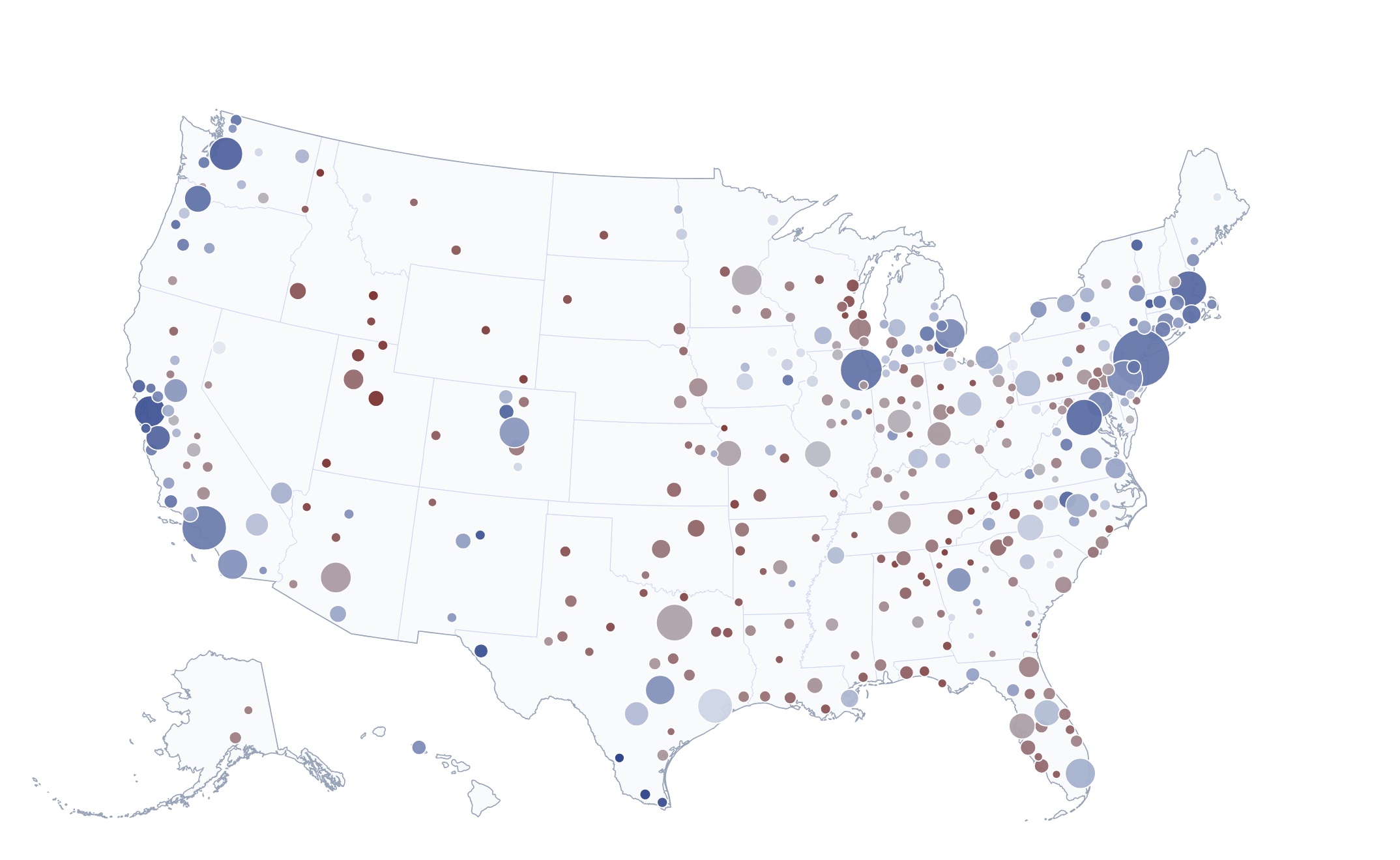
The dataset covers 2012 through 2024 and brings together data on 534,000 employers and 24.5 million workers by linking U.S. voter registrations to electronically available worker profiles. Hurst says one of the project’s main goals was to figure out to what extent people were exposed to people who were politically different from them at work.
“There’s a lot of work in social psychology suggesting that for intergroup interactions to decrease animosity or prejudice, there must be certain conditions. Those interactions are much more likely to decrease animosity when you are working together for a shared goal but under the same leadership,” he says, noting that the workplace is one of the only places where people who have different political beliefs consistently work together with a shared goal.
The data can be visualized and downloaded on the Politics at Work website, where the researchers break down partisan data by geographic region, industry and occupation, as well as by organizations. The data shows that some industries tend to lean more Republican, like the oil and gas industry. Hurst also notes that more pilots tend to be Republican while professors, museum curators and writers tend to have a more liberal lean. Referencing visualizations on the website, Hurst points out the field of finance leans more toward the Democratic party, “which I think is kind of surprising to people.”
To ensure accuracy of their estimates, the researchers conduct extensive benchmarking against census data and nationally representative surveys. Initially, their analysis documented what they thought was a pretty significant increase of polarization over the research period. They spent about a year reviewing their analysis and concluded that the increase in polarization was actually “modest.”
Hurst references other academic work, which provides evidence of partisan “sorting” in relationships, showing Democrats and Republicans are less likely to date across the aisle or have friendships with people who have differing political views. But he says his team’s work points to the possibility that the workplace “might actually be a place where there is kind of consistent, sustained interaction of people with different politics.”
Part of the explanation, he says, is that people tend to have less ability to choose who they work with than who they socialize with outside of work. Where you work and how you support your family is partially dictated by who is willing to hire you.
Working with people of different political views may be something to navigate once you start the job, Hurst says. “But one way or another, you are going to be in an environment where there’s going to be a meaningful number of people that are not like you,” which he adds, creates an opportunity to break down political stereotypes and become less polarized.
The research also notes how companies fare in terms of partisan leaning. “Companies have become more vocal on political issues in ways they haven’t been historically. There is suddenly this interest in the firm as a partisan political entity, not just something that responds to regulations or lobbies,” Hurst says. But this information leads to transparency, which he says he thinks is a good thing. “If our data helps to show that certain firms are being targeted because of their partisan lean, I think that reflects poorly on whoever is doing the targeting.”
