

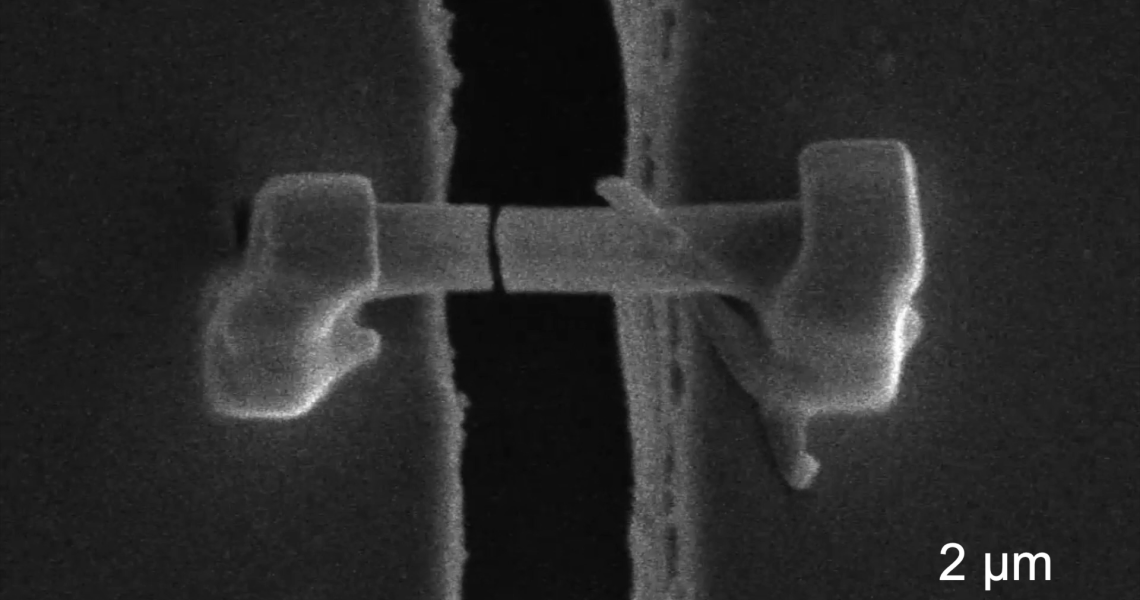
For the first time, scientists have observed how tiny metal “thorns” called dendrites sprout inside lithium-ion batteries, which can cause the batteries to short-circuit. Their findings, published Mar. 12 in the journal Science, shed light on previously unknown mechanical properties of lithium dendrites as they grow.
Scientists have long studied lithium dendrites, but did not fully understand how these structures behave inside batteries. Dendrites form at the nanoscale; their growth is challenging to observe in the closed system of a working battery, but has been linked to battery decline and failure.
The new study, an international collaboration between researchers from universities in the U.S. and Singapore, combined experiments and simulations to provide a first glimpse of how dendrites crystalize, says co-lead author Xing Liu, an assistant professor of mechanical and industrial engineering at New Jersey Institute of Technology and director of NJIT’s Computational Mechanics and Physics Lab.
“This work reflects a close collaboration between experimental and computational mechanics,” and could help improve battery safety, he says.
Co-lead author Qing Ai, a former research scientist at Rice University, adds: “Despite decades of study, the fundamental nanomechanical properties of lithium dendrites remained a mystery ⎯ until now.”
Customized platforms
Measuring about 100 times smaller than the width of a human hair, lithium dendrites (from the Latin word for “branch”) grow from anodes — negative terminals in lithium-ion batteries. Dendrites’ branches can penetrate into a lithium cell’s electrolyte; if dendrites extend from the negatively-charged anode to the positively-charged cathode, they can short out the battery.
“Lithium dendrites are widely recognized as one of the biggest obstacles to the commercialization of lithium-metal batteries,” Liu says. “During battery operation, lithium dendrites can form, break, and become electrically isolated from the lithium metal anode, creating what is known as ‘dead lithium.’ This process leads to a gradual loss of battery capacity over time. In addition, dendrites can penetrate the separator and create an internal short circuit between the anode and cathode. Both capacity loss and short-circuit risks associated with dendrites are commonly observed in lab studies.”
What’s more, lithium dendrites are near-impossible to remove from a battery once they form.
“At present, there is no practical method to ‘clear’ dendrites from a working battery cell,” Liu adds.
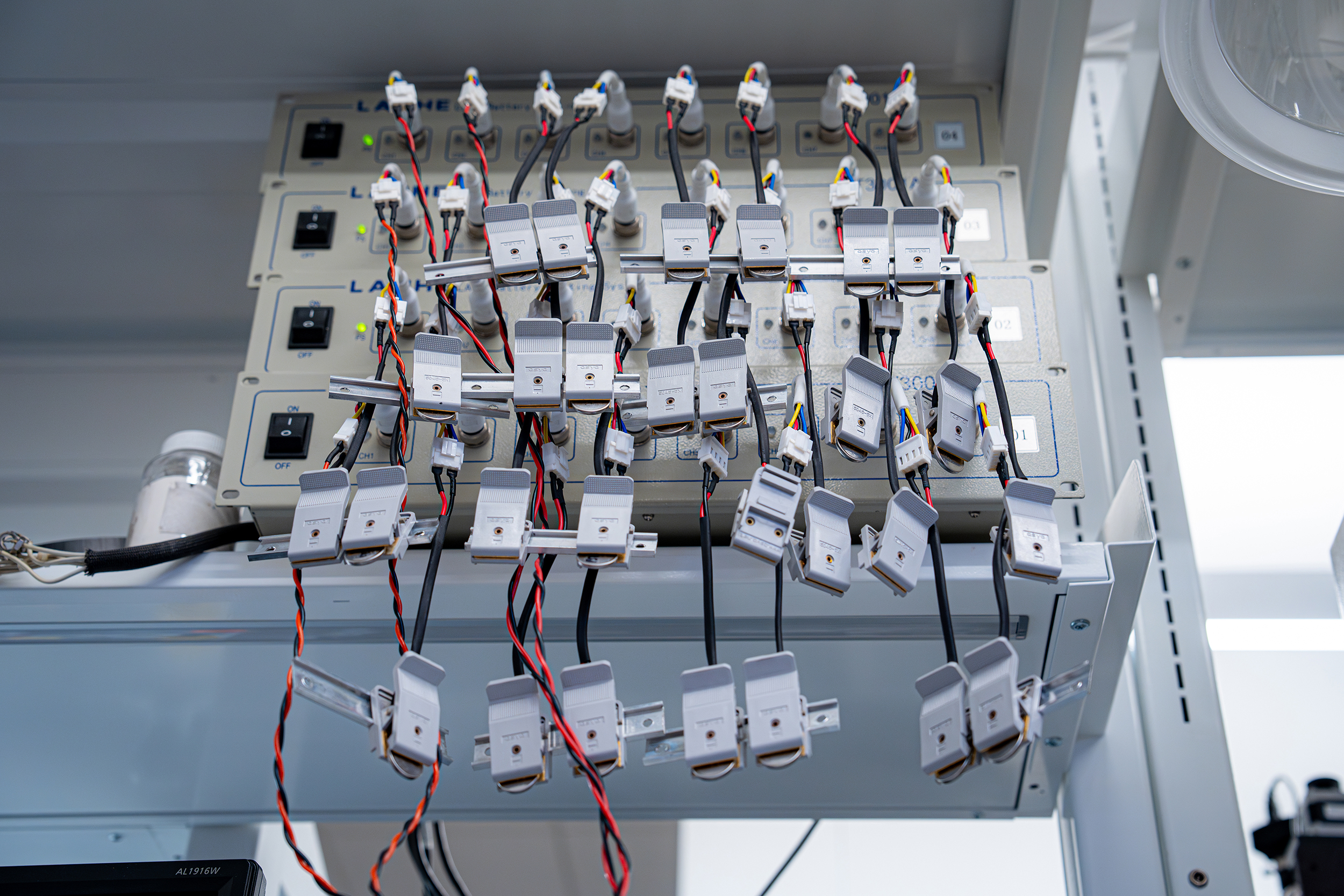
For the new study, researchers at Rice University and collaborators at Georgia Institute of Technology, the University of Houston and the Nanyang Technological University in Singapore harvested dendrites from working batteries to test their mechanical strength.
“To enable the quantitative study of lithium dendrites, we developed customized sample preparation and mechanical characterization platforms for such delicate work,” says Boyu Zhang, a Rice doctoral alum and co-lead author on the study.
Co-corresponding author Jun Lou, Rice’s Karl F. Hasselmann Professor of Materials Science and Nanoengineering, led a team at the Nanomaterials, Nanomechanics and Nanodevices lab in directly probing the mechanical behavior of dendrites as they formed in real batteries. Ai and Zhang, both former members of Lou’s lab, performed the extremely delicate experiments with support from study co-corresponding author Hua Guo and co-author Wenhua Guo of the Rice University Shared Equipment Authority.
To conduct the experiments, they constructed air-tight platforms for preparing and studying samples, as lithium is highly reactive and undergoes chemical and structural changes when exposed to even small quantities of air. High-resolution electron microscopy then revealed how individual dendrites deform in response to controlled stresses.
“Like dry spaghetti”
Lithium in bulk is supple and squishy; lithium dendrites were therefore expected to be similarly pliant. However, the experiments showed otherwise. The University of Houston team, led by co-corresponding author Yan Yao, a professor in the Department of Electrical and Computer Engineering, observed dendrites breaking in real time during battery operation, providing evidence for dendrite brittleness in both liquid and solid electrolyte systems.
“Lithium dendrites have long been assumed to be soft and ductile, like Play-Doh,” Liu says. “But our observations suggest that they may instead be strong and brittle — snapping more like dry spaghetti.”
Teams at NJIT and Georgia Tech then contributed modeling and theoretical analysis of data from the observations.
“We conducted scale-bridging simulations to explain why lithium dendrites behave differently from previously thought,” Liu explains.
They found that as dendrites form in a battery cell, a thin layer of solid electrolyte interphase, or SEI, encases them. The SEI coating makes dendrites rigid and needlelike, capable of piercing battery cells’ separators and electrolytes and prone to snapping under stress, accumulating in the battery cell as fragments of dead lithium and contributing to battery failure.
“Understanding the underlying physics provides new insights into how to make dendrites less prone to brittle fracture — for example, by using lithium alloy anodes,” Liu explains. For researchers who study computational mechanics, mechanisms such as those observed in the study — how structures deform and what makes them shatter and fail — are like musical notes which can be incorporated into a “symphony” of high-performance materials and high-energy storage systems.
“The strengthening mechanism we identified in lithium dendrites adds a new note to this composition,” Liu says.
