

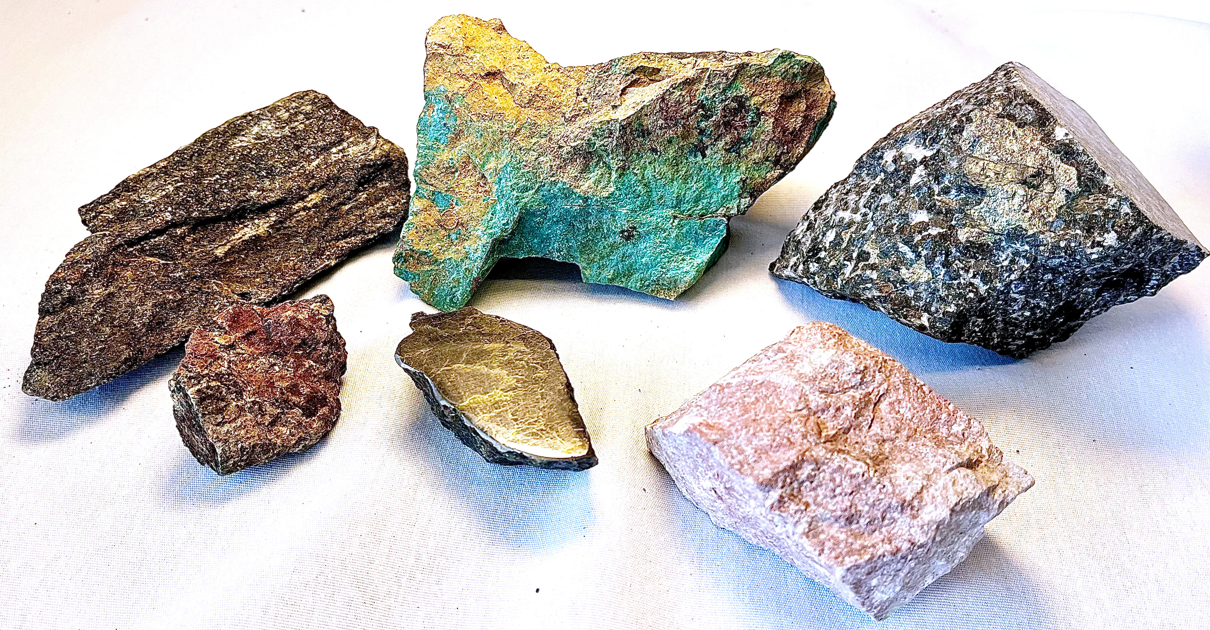
The Idaho National Laboratory (INL) is addressing one of the nation’s most urgent challenges: securing a reliable domestic supply of critical materials. These materials are essential for technologies such as smartphones, satellites and advanced weapons systems that drive the economy and ensure national security.
“Critical materials and metals are crucial to our daily lives; we rely on them,” said Travis McLing, a subsurface research scientist at INL. “However, we depend heavily on foreign entities, jeopardizing our technological leadership, modern lifestyle and national security.”
To address supply chain vulnerabilities, INL uses its geoscience expertise and advanced technologies to develop more efficient methods for locating, extracting and domestically processing critical materials.
INL’s geoscience research supports executive orders aimed at expanding U.S. critical material production to strengthen national security, energy independence and industrial competitiveness.
“With a seven-decade history of fundamental geoscience research, INL has been, and will continue to be, pivotal in helping the nation meet its energy and strategic missions,” said McLing.
Geoscience capabilities
INL geoscientists study the location and distribution of critical materials and analyze how to extract them efficiently. These materials can come from mining, recycled electronic waste (such as computers and cellphones), industrial byproducts, geothermal brines, phosphate and mining waste. INL researchers explore every potential source to lay the groundwork for more strategic and efficient resource development.
“We’ve embraced the national lab charge to do hard things, and we have a proven history of working successfully and safely in challenging environments,” said McLing. “For example, many ore bodies contain elements like arsenic, mercury or naturally occurring radioactive materials that complicate mining and research. Yet we’re able to study them safely and extract the critical materials.”
INL’s geology team examines how different materials are bonded in ore bodies, including both desired elements and hazardous ones. Once these bonds are understood, the information is passed to separation chemists who develop more efficient and environmentally friendly methods for isolating the desired materials.
“Many organizations lack the specialized expertise in advanced geochemistry or the in-house capabilities required to extract minerals from diverse earth materials,” said Trevor Atkinson, another subsurface research scientist at INL. “At INL, we bridge these gaps through targeted research and innovative problem solving.”
INL’s capabilities
Advanced characterization tools:
The Microscopy and Characterization Suite uses powerful tools like electron microscopes and X-ray systems to identify and map critical minerals at very small scales. Understanding the exact makeup and structure of these minerals helps improve extraction methods, making mining strategies more efficient and effective.
Next-generation exploration:
Scientists at INL use advanced software to integrate geologic, geophysical and geochemical data to build high-resolution models of underground formations. This process helps identify resource-rich zones in the U.S. while reducing exploration time, cost and environmental impact.
AI and digital twins:
INL uses artificial intelligence (AI) and digital twin technology to speed up mineral discovery and optimize production. Digital twins are virtual replicas of mineral systems and processing operations that allow scientists to test and refine strategies before implementation. AI models trained on large geoscience datasets help predict deposit locations, identify patterns and support real-time decision making. These tools improve accuracy, reduce risk and support more efficient mineral extraction.
Simulating real-world conditions:
The Multiphysics Object-Oriented Simulation Environment (MOOSE) is an advanced software tool that helps scientists and engineers simulate complex physical processes such as heat, mechanical stress and fluid flow. Its versatile modeling capabilities apply to fields like nuclear engineering, energy systems, environmental science, materials science and geoscience. Using MOOSE can optimize mining practices to maximize critical material extraction, leading to more efficient and cost-effective operations.
Smarter processing and recovery:
INL is working on increasing the efficiency of comminution — the process of grinding and crushing rocks to a more manageable size — and beneficiation, which improves ore quality by separating valuable materials from rock. INL’s efforts make these processes more efficient, maximize the recovery of desired materials, reducing the energy needed and making domestic production more economically viable.
Geometallurgy of rare earth elements for novel refinement
INL is exploring where rare earth elements and naturally occurring radioactive materials are found within rock formations in the U.S. The geoscience team conducts experiments and uses machine learning to find ways to more efficiently extract and remove rare earth elements from mineral ores.
Uranium studies collaboration
INL is collaborating with UR-Energy at the Lost Creek uranium mining site. The INL team uses portable X-rays to study the chemical and biological conditions of the site before, during and after mining. The team is also creating AI tools to generate detailed underground maps based on drilling data. This work will make the U.S. uranium supply chain, which is essential for America’s nuclear energy needs, more reliable and efficient.
Looking ahead
INL continues to innovate in the field of critical materials research. The laboratory’s efforts are pivotal in ensuring a stable and secure supply of these essential resources. Our capabilities and expertise allow us to contribute to the Minerals to Materials Supply Chain Facility (METALLIC), a multi-laboratory initiative to accelerate the development and commercialization of technologies for critical materials extraction and production. INL’s role includes supporting research in separation science, artificial intelligence, pilot-scale processing, feedstock beneficiation, and critical material extraction and separation. This work is helping to establish a secure, domestic supply chain for critical materials.
“INL benefits from its proximity to the Intermountain West region, which is rich in critical materials,” said McLing. “Our research teams are collaborative; we share what we learn to improve the work of all our teams and, by extension, the economic value and efficiencies for our partners.”
